
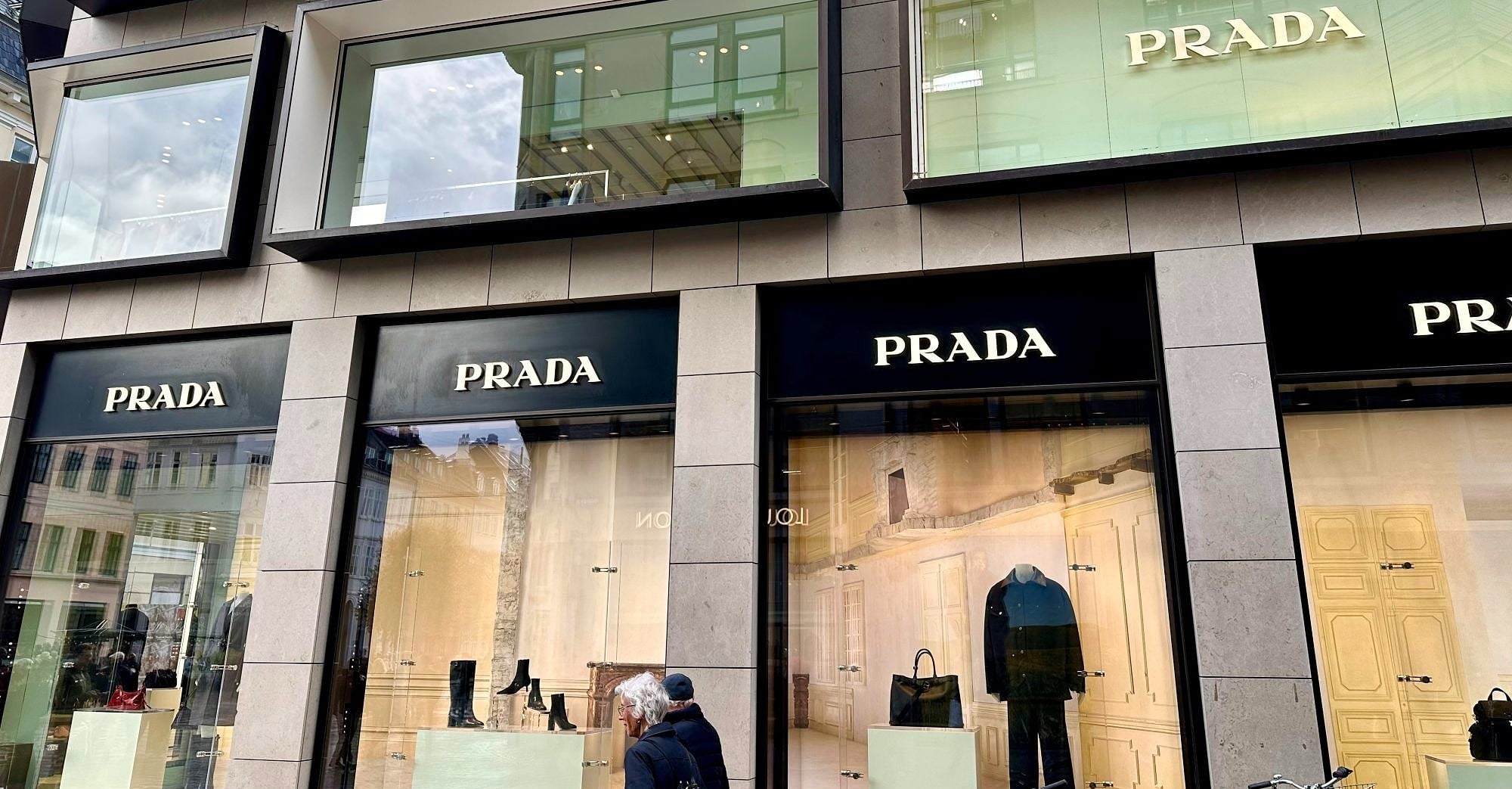
 Prada was built on an argument. For almost 50 years Miuccia Prada has used fashion to question what luxury is, and her husband, Patrizio Bertelli, has turned her answers into an industrial and retail business of global scale. Together they made her grandfather’s leather goods shop in Milan into Italy’s largest luxury fashion group. The two people at the centre of that achievement are handing it on, and they are doing so on three fronts at once: design, management and ownership.
That is the central tension of Prada. Its strength has never been a signature look. It is a way of thinking, held by one designer and made real by one industrialist. A way of thinking is harder to copy than a look, and harder to hand over. The transfer has begun in public. Raf Simons has shared the design of the Prada brand since 2020. Andrea Guerra, a chief executive from outside the family, has led the group since 2023. The couple’s elder son, Lorenzo Bertelli, has been named by the company as its future leader, and he is executive chairman of Versace, which Prada bought in December 2025 in the largest acquisition in its history.
The business being passed on is in good health. Prada Group reported net revenues of USD 6.7 billion for 2025 (year ended December 2025), its fifth consecutive year of growth. It owns Prada, Miu Miu and Versace, the English shoemaker Church’s, Car Shoe and the Milan pastry shop Pasticceria Marchesi. It operates 843 stores and 25 factories, 23 of them in Italy. The family holds about 80% of the shares, and the remainder have traded in Hong Kong since 2011.
This article examines how the Prada brand was built, the philosophy and strategy behind it, the logic of the Versace acquisition and the way the family is preparing its succession. Italy is a country of family enterprises, and many of its best-known fashion houses have passed into other hands. Prada is the rare case of a family business rebuilt by its third generation that went on to become the buyer. How it manages the passage to the fourth will be studied by owner families well beyond fashion.
Prada began in 1913 as Fratelli Prada, a shop opened by Mario Prada and his brother Martino in the Galleria Vittorio Emanuele II, the 19th-century arcade beside Milan’s cathedral. It sold leather bags, trunks and other luxury goods to a wealthy clientele. In 1919 it was appointed an official supplier to the Italian royal family, which allowed it to add the coat of arms of the House of Savoy to its logo. Prada still trades in the arcade.
For more than six decades the business remained what it had been at the start: a respected Milanese name and a small company. It was the founder’s granddaughter who changed its scale, and she came to it by an indirect route. Miuccia Prada studied political science at the University of Milan, trained in mime for five years and took part in the political movements of the period before she joined the family firm in the 1970s to work on accessories. The business came to her through her mother’s family. Her mother, the founder’s daughter, had run it since the 1950s, and Miuccia Prada took it over later in that decade.
The decisive event was a partnership. Patrizio Bertelli, a Tuscan entrepreneur with a leather goods company of his own, began working with her in 1977. His company took a licence to produce and distribute Prada leather goods, and the two businesses were later merged into one group. They married in 1987. She designed. He built the organisation around her work: the factories, the quality standards, the stores and in time a global distribution network. The company dates its modern history from that combination of what it calls creative and entrepreneurial strengths.
The first breakthrough was a material. In 1984 Prada introduced a backpack in black nylon, a hard-wearing synthetic fabric then foreign to luxury leather goods. It was light, practical and marked only by a small triangular logo. It became one of the defining accessories of its era, and it set the pattern for what followed. Something ordinary or out of favour is treated with complete seriousness and made desirable.
Women’s footwear had been added in 1979, and the first women’s ready-to-wear collection was shown in Milan in 1988. Its plain, exact clothes ran against the decorative glamour that dominated Italian fashion at the time. Three further steps came in 1993: Miu Miu, a second brand named after Miuccia Prada’s childhood nickname, the first menswear collection, and Fondazione Prada, the contemporary art foundation created by the couple. By the middle of the 1990s Prada was among the most influential names in fashion. Its spring/summer 1996 collection, in colours and prints then considered bad taste, attached the phrase ugly chic to the house for good. Its influence spread well beyond its own customers. By 2004 a critic of The New York Times could describe a New York season in which designers at every price level, from luxury labels to mall chains, were working in the Prada style.
Success brought ambition of a different kind. At the end of the 1990s, as LVMH and the Gucci group were assembling portfolios of brands, Prada set out to build an Italian equivalent. In 1999 it bought control of Jil Sander and Helmut Lang, two of the most admired designer labels of the decade, acquired the shoemaker Church’s and took a stake in Fendi alongside LVMH. The strategy did not hold. Both designers left the labels that carried their names. The debt taken on to fund the purchases weighed on the group, and a stock market listing planned for 2001 was abandoned. The Fendi stake went to LVMH in 2001, and Jil Sander and Helmut Lang were sold in 2006. Patrizio Bertelli has since called the two acquisitions strategic mistakes.
The repair took the rest of the decade. Prada concentrated on its own brands, opened stores across Asia and reduced its debt. Four attempts to list its shares had been postponed or withdrawn by the time the company chose Hong Kong over Milan. On 24 June 2011 Prada became the first Italian company to list there, under the stock code 1913. The offering raised USD 2.14 billion for the company and its shareholders, and the family kept about 80% of the shares.
Rapid expansion followed, and then a hard lesson. Sales and profit fell for several years in the middle of the decade. The group had opened too many stores in China and had raised its prices sharply. It had also been slow to respond to new demand, notably for luxury sneakers, and slow to sell online. A turnaround led by the family began in 2017. The product offer was renewed, digital channels were built, wholesale distribution was cut back and in 2019 the group ended seasonal markdowns. Lorenzo Bertelli joined in 2017 to lead digital communication, and his father later called him a key element of the recovery.
By early 2020 investors expected one of two things: a sale to a larger group or an overhaul from within. The family chose the second, and three decisions reshaped the house. In 2020 the Belgian designer Raf Simons joined Miuccia Prada as co-creative director of the Prada brand, with equal responsibility for its collections. In January 2023 Andrea Guerra, the former chief executive of Luxottica, became group chief executive, the role the couple had shared. He is the first person from outside the family to hold it. Patrizio Bertelli moved to the chair, and Miuccia Prada continued to lead design. In April 2025 the group agreed to buy Versace from Capri Holdings for about USD 1.4 billion, and the purchase was completed on 2 December 2025.
The business grew through all of it. Miu Miu, long regarded as the younger sister of Prada, became one of the fastest-growing names in luxury. Its retail sales rose by 93% in 2024 and by a further 35% in 2025. By the end of 2025 the group had reported 20 consecutive quarters of growth while much of the luxury sector was contracting. The first half of 2026 showed the cost of the new chapter as well as its momentum. Revenue rose by 16% at constant exchange rates, or 5% excluding Versace. Net income fell by 15% as the group consolidated Versace, which is loss-making. Profitability in the rest of the group was stable.
Most luxury houses are recognised by a look. Prada is recognised by an attitude. Miuccia Prada has changed direction from one season to the next for almost four decades, and the brand has remained unmistakable throughout. The consistency lies in the thinking behind the clothes. Five ideas run through that thinking. They explain the strength of the brand, and they define what has to be handed on.
Fashion as a way of thinking: Miuccia Prada treats fashion as a subject to be thought about as well as a product to be sold. She came to it from politics and theatre, and she has always measured her work against art, film and architecture. She has called the distance between her political convictions and her work for a luxury company the biggest contradiction of her life. A 2004 profile in The New Yorker recorded the three questions she asked of every collection: “Do I like the clothes? Will they sell? And are they new?” The commercial question sits in the middle of the list, and she has never treated it as an embarrassment. The company exists to sell clothes, she told the Financial Times in 2026, and “if I did not want to do something that sells, I would change jobs”. Asked in the same interview whether the three questions still applied, Raf Simons answered for her that they had not changed. The intellectual reputation of Prada has never been an alternative to commerce. It is the reason customers buy.
Beauty that includes the ugly: From the start she set herself against the idea that fashion exists to flatter. Fashion, she has said, was expected to be about glamour and beauty alone, and it became her direction to bring in the ugly side of life. She gave her reason in 2013: “Because ugly is human.” Colours, proportions and materials that others had rejected became her vocabulary. The commercial insight is easily missed. A brand that accepts the conventional definition of beauty competes with every other brand that does the same. A brand that redefines it has the field to itself for as long as its customers trust its judgement.
Usefulness before fantasy: Luxury is usually sold as a dream. Miuccia Prada dislikes both words. Clothes, in her view, belong to real life. People need something useful for their lives, she said in October 2026, clothes that may well make them attractive, but in a real context and not an imagined one. The nylon backpack was the first statement of that position, and it explains the place of plain materials, uniforms and workwear in her collections. It also gives the brand a particular relationship with its customer. Prada does not promise transformation. It offers intelligent equipment for the life the customer already leads, and it assumes that she can tell the difference.
Change as a discipline: Where Giorgio Armani refined a single vocabulary for 50 years, Prada changes its own every season. Raf Simons describes two types of designer, one who finds a style and keeps it and one who is always changing, and he places Prada firmly among the second. Miuccia Prada attributes the habit to boredom, which she calls one of the most important things in her life because it makes her want to change. The risk of such a method is incoherence. Prada avoids it because each collection is a reaction to the house’s own previous position. Customers have learned to expect the unexpected from one source, and that expectation is a form of consistency. She does not design to what customers want, and says so. What keeps her connected to them is curiosity, and the young people she works with at the company and the foundation. The method has a price, and she is candid about it. She has acknowledged that a demanding Miu Miu collection for spring 2026 was not a complete commercial success.
Culture as part of the product: Prada has always worked across art, architecture, film and design. For decades Miuccia Prada kept those activities apart from the fashion, wanting each to be judged in its own field. She rejects the idea that the house sponsors culture. The aim, she has said, is to take part in creating it. In 2026 she brought the two sides together in a permanent exhibition in Milan and explained why. The reason Prada is Prada, she said, is that it was always open to many other fields, and that without those connections it would not exist. The remark is an accurate description of the brand. Her own office at the Milan headquarters has an artwork for an exit, a slide by the artist Carsten Höller. The foundation, the buildings and the films are the source of the house’s ideas, and they are the reason a Prada product carries meaning beyond its design.
The next generation describes the brand in the same terms. Lorenzo Bertelli said in 2023 that the identity of Prada is in the end a perspective on things, a view of modernity, culture and sport that goes beyond fashion.
For leaders, the implication cuts both ways. A brand built on a point of view is very hard to imitate, because competitors can copy a product and cannot copy the judgement that produced it. For the same reason it is hard to hand on. Giorgio Armani’s principles could be written into company bylaws. Prada’s principle is a habit of questioning, and a habit has to be taught. By her own account, Miuccia Prada now spends much of her time doing exactly that.
Prada is usually described as the creation of a designer. It is the creation of a partnership, and the business cannot be understood without its second half.
Patrizio Bertelli supplied what most designer-led houses lack: an industrial base and a retailer’s discipline. He built the factories, set the standards of quality and insisted on control over how and where the product was sold. Miuccia Prada supplied the ideas that made the product worth controlling. Each needed the other. Her collections were often difficult and ahead of the market. His organisation gave them the time and the distribution to find their customers. In 2011, announcing record results, he described the outcome as a strong industrial and distribution platform, able to seize the best opportunities in every market. The two ran the company together for decades, latterly as joint chief executives. Asked why the partnership had worked, he has said that they never worked to become rich or famous, but “for the pleasure of doing something that was interesting and constructive”. Disagreement is part of the method. The family’s way of working is discussion and debate, and in Lorenzo Bertelli’s view different opinions produce a better result.
The pairing of a designer and a business partner is familiar in luxury. Giorgio Armani had Sergio Galeotti, Yves Saint Laurent had Pierre Bergé and Valentino Garavani had Giancarlo Giammetti. What distinguishes Prada is duration and structure. The partnership has lasted almost five decades. It is a marriage as well as a business arrangement, and both partners are owners. Creative and commercial authority have therefore been held within one household, and no outside shareholder has been in a position to tip the balance between them.
The model has three advantages. Decisions are fast, because the two people who must agree are in daily conversation. The horizon is long, because the owners are investing their own capital and their own name. And creative risk is underwritten by commercial discipline, which is why a house known for difficult ideas has also proved a durable business. The weakness is the mirror image of the strength. A partnership of this kind concentrates two indispensable roles in two people of the same generation. When they step back, the company has to replace a designer, an industrialist and the conversation between them. Paola Cillo of Bocconi University in Milan observed in 2023 that the way the two complement each other is very difficult to replicate.
The couple have approached that task by dividing their roles among several people. The design of Prada is shared with Raf Simons. Executive management has passed to Andrea Guerra. The next generation of the family is represented by Lorenzo Bertelli.
The change goes deeper than three appointments. Since 2017 the group has built a layer of professional management. Miu Miu received its first dedicated chief executive in 2020 and the Prada brand in 2023, and new heads of finance, legal affairs and human resources were appointed in the same period. Lorenzo Bertelli said in 2023 that the team was completely new compared with two years earlier. Fashion, in his comparison, has become like sport, where talent alone no longer wins and a structure and an organisation are needed. A house built on two exceptional talents is being rebuilt as an organisation. How that design is intended to work is examined in the sections on Versace and on succession below.
Prada Group is a house of few brands. It has no pyramid of sub-labels in the manner of Armani and no portfolio of some 75 houses in the manner of LVMH. It has two brands created by the same designer, one large brand acquired in 2025 and a handful of specialists. When the Versace agreement was announced, the company estimated that Prada would account for 64% of the combined group’s revenue, Miu Miu for 22% and Versace for 13%. Each brand keeps its own creative identity. What they share is the group’s factories, its retail expertise and its owners.
Prada: The founding brand and the centre of the group. It sells leather goods, footwear and ready-to-wear for women and men, and since 2020 its collections have been designed jointly by Miuccia Prada and Raf Simons. Prada Linea Rossa, launched in 1997, is its line of technical sportswear. Fine jewellery and a home collection were added in the early 2020s.
Miu Miu: Created in 1993 and designed by Miuccia Prada alone. She has drawn the distinction herself. Prada is the thinking part, more rigorous and more intellectual. Miu Miu starts from the same ideas and is more instinctive and more fun. For most of its history Miu Miu was regarded as the younger sister, which was never quite accurate. It is not a diffusion line, the cheaper second label that many houses use to reach a wider public. It is priced at the level of Prada, and she regards the two brands as equally important. Since 2022 it has been the group’s engine of growth and a major brand in its own right.
Versace: Founded by Gianni Versace in 1978 and part of the group since December 2025. Its language of colour, print and overt glamour is close to the opposite of Prada’s. That is the logic of the purchase. The two brands do not compete for the same customer. Versace is run as a separate house with its own creative leadership.
Church’s, Car Shoe and Marchesi: Church’s, the English shoemaker founded in 1873, joined the group in 1999. Car Shoe, the Italian maker of driving shoes founded in 1963, followed in 2001. The group took control of Pasticceria Marchesi, a Milan pastry shop founded in 1824, in 2014. They are small in the group’s accounts. Their role is to root it in craft, in Milan and in the pleasures that surround fashion.
Luna Rossa: The group also counts among its brands the sailing team that Patrizio Bertelli launched in 1997 to challenge for the America’s Cup. It is discussed under brand communication below.
Licensed categories: Two categories are entrusted to global specialists. Eyewear has been made under licence by Luxottica, now EssilorLuxottica, since 2003. The agreement for Prada, Prada Linea Rossa and Miu Miu was renewed in December 2024 to the end of 2030, with provision for a further five years. Beauty moved to L’Oréal under a long-term licence signed in December 2019, which took effect in January 2021, and an agreement for Miu Miu followed in February 2024. Armani works with the same two partners, for the same reason. Beauty and eyewear require scale in research, production and distribution that a fashion house does not possess, and they introduce the brand to customers who may never buy a handbag.
The architecture reflects a clear view of where control matters. Everything that defines the brands is owned, from design and manufacturing to the stores. Categories that depend on scale are licensed to the strongest operator available. The portfolio is kept small enough for the owners to know each brand in detail. The acquisitions of 1999 departed from that principle and were reversed. Versace is the first major test of whether the group can add a third large brand without repeating the experience.
Behind the brands lies a strategy that the group has applied with growing consistency since its turnaround. It can be summarised in five principles.
How Miu Miu became the second engine: The growth of Miu Miu was the result of deliberate choices, and the method deserves attention. The brand was given an identity of its own early. Its collections have been shown in Paris since 2006, apart from Prada in Milan. In 2020 it received its first dedicated chief executive, Benedetta Petruzzo, and a team of its own. The same year brought a less visible change. Raf Simons joined her at Prada, and she said two years later that she was concentrating on Miu Miu. Sharing the first brand gave her time for the second. The positioning was then widened from youth to what Benedetta Petruzzo described in 2024 as a youthful energy linked to attitude and not to age. Collections combined pieces designed to start a conversation, such as the miniskirt of spring 2022, with wearable staples and a stronger range of leather goods. The store network was reduced while sales rose. Miu Miu grew from 12% of group sales in 2022 to about a quarter of retail sales in 2024. Lorenzo Bertelli worked closely with the design and commercial teams on the change. The lesson for owners of more than one brand is that a second brand needs its own management, its own identity and time.
The implication for brand owners is that these principles reinforce one another. Owned stores make full prices possible. Full prices fund Italian manufacturing. Manufacturing protects the product that the stores exist to sell. Patient ownership pays for all three in the years when the market does not.
Prada communicates differently from most luxury brands. Unlike Armani, Versace or Valentino, it has never been personified by its designer. Miuccia Prada welcomes the fact. When it was put to her in 2026 that the identity of Prada is not her own, she replied: “Good, that means they can live without me.” The brand has been built through institutions and places that carry authority of their own. Four stand out.
Art: Fondazione Prada was created by Miuccia Prada and Patrizio Bertelli in 1993 and has become a leading institution for contemporary art. Its Milan home, designed by the architect Rem Koolhaas, opened in 2015, and it has further venues in the Galleria Vittorio Emanuele II and in Venice. It also plays a civic role. Milan’s public museums had little room for contemporary art, and the foundation has filled much of that gap. Its exhibitions are not about fashion and make no attempt to sell it. That distance is its value. It gives the Prada name standing among people who would resist a brand that asked for it directly.
Architecture: Prada treats its buildings as statements. The first Epicenter store, designed by Rem Koolhaas, opened in New York in 2001. Tokyo followed in 2003, designed by Herzog & de Meuron, and Los Angeles in 2004. They were conceived as more than shops, with room for technology, events and experiment. Patrizio Bertelli said in 2024 that the group had been accused of consumerism at the time, when it had in fact seen how customer demand would shift. The collaboration with Rem Koolhaas extends to the runway. His studio has designed the sets for Prada’s shows since 2004, and they are staged at the foundation. In Shanghai the group restored Rong Zhai, a mansion completed in 1918, over six years and opened it in 2017 as a home for its cultural activities in China. In September 2026 it opened Pradasphere, a permanent exhibition of the house’s history, in the Milan arcade where the first shop opened in 1913.
Sport: In 1997 Patrizio Bertelli founded the Luna Rossa sailing team to challenge for the America’s Cup. It has competed for the trophy repeatedly since 2000, including at the 37th America’s Cup in 2024. Linea Rossa, the brand’s sportswear line, dates from the same year. The team has given Prada a presence in sport and technology, and it is not a sponsorship at arm’s length. Sailing is a personal passion of the chairman, and the group lists Luna Rossa among its brands.
Film and popular culture: The Devil Wears Prada, a novel in 2003 and a film in 2006, carried the name far beyond the luxury customer, and its sequel was one of the biggest films of 2026. Asked about the sequel, Miuccia Prada said she had not seen it. The episode shows a name that has entered popular culture on its own momentum. The group’s own work in film is quieter. Miu Miu commissions short films from women directors in a series called Women’s Tales.
The same instinct explains less expected projects, such as the work with Axiom Space on the spacesuit for NASA’s Artemis III lunar mission, presented in 2024.
The common thread is that Prada borrows authority from fields with standards of their own and lets the association speak. The approach is slow and costly, and it cannot be copied quickly. For the next generation it is an inheritance that needs active management. Lorenzo Bertelli has defined the task as making that authority known to a wider public without diluting it. The house has great credibility, he said in 2023, but many people do not know it, and it has to be made known. The fashion itself, he added, must keep a certain purity. Institutions that grew from the personal interests of two people also have to be given a purpose that outlasts those interests.
Manufacturing in Italy is part of what Prada sells. It has also become one of the most exposed parts of the luxury business model.
Italian luxury production depends on thousands of small workshops, many of them subcontractors to the suppliers that brands deal with directly. Since 2024 courts in Milan have placed units of several well-known houses under judicial administration over the supervision of their subcontractors. Under this measure a court appoints a commissioner to oversee the unit, typically for a year, while its controls over suppliers are put right.
Prada is not under investigation. In December 2025 prosecutors asked the group for information about its supply chain, and in January 2026 the company disclosed what its own controls had found. Since 2020 it has carried out more than 850 inspections of its Italian suppliers and subcontractors and has ended its relationship with 222 of them. More than a quarter of the inspections led to a termination. The group works with about 1,000 suppliers and registered subcontractors in northern and central Italy. It has said that so fragmented a chain is very difficult to control and that it is committing significant resources to the task.
Two points follow for brand owners. Owning factories reduces the exposure, which is one reason the 23 Italian plants matter. And where production is outsourced, audit has moved from a compliance function to a part of brand management. A luxury price is a claim about how a product was made, and the claim has to be verifiable.
Sustainability is led from within the family. Lorenzo Bertelli has been head of corporate social responsibility since 2020 and is a member of the board’s ESG committee, formed in 2022. The best-known initiative is Re-Nylon, launched in 2019, which remakes the house’s signature fabric from recycled nylon. Since 2023 a share of the proceeds of a dedicated Re-Nylon collection has supported an ocean education programme that the group has run with UNESCO since 2019. Giving the designated successor responsibility for this agenda is a considered choice. It ties the authority of the next generation to the long-term standing of the company, which is the essence of stewardship.
Prada understood early that much of its future lay in Asia, and it acted on that understanding in an unusually public way.
By 2010 the company had a familiar problem and an unfamiliar answer. It needed capital to open stores and reduce debt, and its earlier attempts to list had come to nothing. Asia was already its largest region, at more than 40% of sales and growing much faster than Europe. Patrizio Bertelli set out the reasoning in an interview that year. A listing could be a solution, he said, and if a stock exchange represents a market, a company should list where things are happening. When the shares began trading in Hong Kong in June 2011, he presented the chairman of the exchange with a red Prada handbag in a glass case and said that Greater China would be one of the most interesting prospects in the luxury industry.
The listing achieved three things. It raised capital from investors who knew the Asian luxury customer at first hand. It put the Prada name before the region’s investors and media at the moment when Chinese demand for luxury was growing fastest. And it left control with the family. A European family company used an Asian capital market to finance global growth without giving up control. L’Occitane had taken the same route a year earlier, and Samsonite listed in the same month.
The years that followed showed the other side of the decision. The group opened more stores in China than demand could support, and a house that draws so much of its growth from one region shares that region’s cycles. The balance has improved since. In 2025 Asia Pacific was the group’s largest region, at a third of retail sales, and Japan added a further 13%. Europe accounted for 31% and the Americas for 18%. The Americas were the fastest-growing region of the year, which gives the group a broader base than it had at the time of the listing.
The group has invested in presence as well as stores. Rong Zhai in Shanghai is a cultural venue and not a shop. It reflects an understanding that standing in a market is earned through commitment to the place.
Asia has also taught the house a lesson in respect for heritage. In June 2025 Prada showed sandals in Milan that closely resembled the Kolhapuri chappal, a handmade leather sandal with centuries of history in western India, without naming the source, and was criticised for it in India. The group acknowledged the Indian origins of the design. In December 2025 it agreed with two state-backed leather industry bodies to produce a limited edition in India with local craftspeople, together with a three-year training programme. Lorenzo Bertelli said that the aim was to multiply awareness of the craft. The principle holds for any global brand that works with heritage belonging to others. Name the source, involve its makers and share the value.
In April 2025 Prada agreed to buy Versace from Capri Holdings, the American owner of Michael Kors, for about USD 1.4 billion including debt. Capri sold in order to reduce its debts, after regulators had blocked its own merger with a larger American rival in 2024. The purchase was completed on 2 December 2025. It is the largest acquisition in the group’s history and its first major purchase since 1999. It brings together two houses from the same city with almost opposite ideas of fashion.
The logic rests on four arguments.
A brand larger than its business: Versace is one of the most recognised names in fashion. Its revenues, at about USD 800 million in 2025, are small for a brand of that recognition, and the business is loss-making. Lorenzo Bertelli said in November 2025 that the brand is much bigger than its turnover, and that the group is ready for difficult missions such as bringing the business back to the level of its name. Capri Holdings had paid about USD 2.15 billion for it in 2018. Prada bought a famous name at a low point, for well below the previous price.
A different customer: The Prada and Versace customers are different people. Lorenzo Bertelli said when the deal was announced that the two brands do not overlap in creativity or in customers. A group whose two main brands share one designer gains a third with a separate identity, a separate clientele and separate creative leadership.
A platform ready for use: What Prada brings is the system described in this article: Italian factories, experience of running stores at full price and patient owners. Andrea Guerra told analysts that the purpose is to grow revenue over the long term, not to cut costs. The plan disclosed so far is to move Versace away from discount channels and wholesale towards full-price sales in its own stores, to bring it onto the group’s manufacturing base and systems and to accept lower sales and continued losses while that is done. The distance to cover is considerable. In late 2024 Versace was selling about 40% of its products at a discount. Lorenzo Bertelli intends to apply what the group learned in expanding Miu Miu.
An Italian owner: The purchase returns a Milanese house to Italian ownership after seven years in an American group. Miuccia Prada has called Versace a very important brand, one she preferred to see with Prada than in other hands. Italy never produced a luxury group on the scale of the French ones. Prada with Versace is the closest it has come.
The decision marked a change of course. As late as May 2024 Andrea Guerra said that large acquisitions were not on the horizon and that the group was focused on its own brands. Eleven months later it agreed to buy Versace. Analysts were cautious. Luca Solca of the research firm Bernstein said the market viewed the deal with some scepticism, while noting that Prada had not overpaid.
The risk is defined by the group’s own history. Jil Sander and Helmut Lang were also admired brands bought to build a portfolio, and both purchases failed. Miuccia Prada has given her explanation. The designers expected nothing to change after the sale, and the industry had not yet learned how such partnerships work. The purchases, she said in 2026, came too early, at a time when no one had yet bought anything.
Three things are different this time. Versace no longer depends on a founding designer. Donatella Versace, who had directed its collections since 1997, stepped down as chief creative officer in 2025 and became the brand’s ambassador. The creative leadership was therefore the new owner’s to choose. Prada appointed Pieter Mulier, previously creative director of Alaïa and a long-time collaborator of Raf Simons, as chief creative officer from 1 July 2026. He reports to Lorenzo Bertelli, who says that the group identified him as the right designer while it was still weighing the acquisition. His first collection is due in February 2027. Patience will be needed. Bernstein calculates that a brand’s earnings peak about five years after a new creative director arrives. The group is also far stronger than it was in 1999. It borrowed to fund the purchase, but from a position of net cash and high margins. And the family has placed its own successor in charge.
The appointment of Lorenzo Bertelli as executive chairman of Versace is the most significant governance fact about the deal. By his own account the acquisition would not have happened without him. He and Andrea Guerra carried it out between January and March 2025, and he has tied it directly to the handover: “It needs to be viewed in the context of the succession … Since I represent the future of the company, it is normal that if I hadn’t wanted to do it, we wouldn’t have done it.” The chairmanship gives the acquired brand the direct attention of the owning family. It gives the designated future leader of the group a business of his own to repair, after his part in the turnaround of Miu Miu. He has set the tone himself, saying that the group is neither in a hurry nor anxious. The first year has brought change at the top. Dario Vitale, who came from Miu Miu and was appointed chief creative officer shortly before the sale was agreed, left in December 2025 after a single collection, and the chief executive resigned in June 2026. The company said that new governance for the brand would be announced. Changes of this kind are common after an acquisition. They also mean that the new team begins its work in the second half of 2026. The company does not expect the group’s operating margin to resume its improvement before 2027.
For owner families the case is instructive whatever its outcome. An acquisition is one of the few ways to give a successor real authority before the top role falls vacant. It carries real risk for the same reason. The family has chosen to make the test visible, measurable and early, while both parents are present to advise. That is a more demanding design than a title without a business attached.
Versace carries a second lesson for owner families, from its own past. Gianni Versace died in 1997, and his sister Donatella took on responsibility for the house overnight. She has since said that she may not have been prepared for it. Revenue fell from more than USD 1 billion to about USD 400 million over the following decade, before she rebuilt the brand. An unplanned succession cost the house a decade. It is the outcome that the Prada family’s own planning is meant to prevent.
Italy is a country of family enterprises, and some of them are very old. The Antinori family has made wine in Tuscany since 1385 and counts 26 generations in the business. Beretta, the firearms maker, traces its history to 1526 and 15 generations. Family ownership remains the rule well beyond such cases. Roughly two-thirds of the country’s mid-sized and large companies are family firms, according to the AUB Observatory of AIDAF, UniCredit and Bocconi University. The pattern reaches the largest companies too. An analysis by The Economist in 2026 found that family firms make up nearly a quarter of the world’s large listed companies and one in seven of those in Europe.
Longevity on that scale is the exception. The Italian saying for the usual pattern runs “from stables to stars to stables”. The country’s family firms also face a demographic test: AIDAF, the Italian association of family businesses, expects about a third of them to pass to a new generation by 2034. Many owners have chosen to sell, often to private equity firms. Almost 3,500 such transactions took place in Italy between 2013 and 2025, according to estimates by Pictet and Politecnico di Milano.
Italian fashion shows both outcomes. Many of its great names were built by families and are owned by larger groups: Gucci and Bottega Veneta by Kering, and Fendi, Bulgari and Loro Piana by LVMH. Scale has been the argument for selling. The three largest groups, LVMH, Kering and Richemont, raised their share of global sales of personal luxury goods from 19% in 2014 to 31% in 2023, according to the consultancy BCG. Versace was sold by its founding family in 2018. Others, among them Zegna and Ferragamo, remain under family control, and Giorgio Armani left his company to a foundation and his heirs with instructions to bring in an outside shareholder.
Prada belongs to a smaller group still. It is a family business that was rebuilt by its third generation into something its founder would not recognise, and it is the family house that became an acquirer. Uniqlo offers a parallel from Japan: a second generation that used an inherited company to build a different business. The lesson is the same in both cases. The most valuable contribution of an incoming generation is often to redefine the business, and the most valuable gift of the outgoing one is the room to attempt it. Continuity is part of the family’s character as well as its strategy. Miuccia Prada still lives in the house in which she was born, and the shop her grandfather opened in 1913 still carries the family name. Prada’s question is how the fourth generation takes over from the third.
Ownership: The family controls Prada S.p.A. through Prada Holding, which owns about 80% of the shares. The rest are held by public investors through the Hong Kong listing. The owners of the holding company are Miuccia Prada, members of her family and Patrizio Bertelli. Lorenzo Bertelli has sat on its board since 2015 and on the board of Prada S.p.A. since 2021. The structure is simple and concentrated. A listed company with a controlling family shareholder of this size has access to capital markets and the certainty that its strategy will be set by its owners. The family has been careful about how far it opens the capital. A second listing in Milan was studied from 2022 and set aside, and Lorenzo Bertelli said in November 2025 that there was no plan in the short term. A study published in 2026 by Politecnico di Milano and the law firm Legance argues that families who bring in outside capital do best when they have agreed beforehand which decisions stay with the family. Prada settled that question at its listing in 2011 and has not reopened it. Hermès protects its independence in a comparable way, through a holding company that pools the family’s shares.
Ownership before control: The passage of ownership to the next generation has begun. Italian filings reported in November 2024 show that Miuccia Prada has transferred ownership of almost all of her shares in the family’s holding entities to her two sons, while keeping the voting rights. The next generation owns the shares, and the senior generation continues to vote them. Patrizio Bertelli has kept control of his own holding, so the transfer is being made in steps. Both sons are owners, and one of them works in the business. The arrangement separates two successions that families often run together. Ownership can pass early, while control stays with the senior generation until the next is ready to exercise it.
A succession announced in advance: Patrizio Bertelli formally named his son as his successor at an investor presentation in November 2021, and said he could hand over in three years. He added that he had named three years because of his age and that he was not anxious about it. In December 2022 the couple announced that they would give up the role of chief executive, which they had shared, and explained why. The step was taken, they said, “to ease the succession of Lorenzo Bertelli, the future leader of the group”. Few families name their direction so plainly or so early, and many have no plan at all. Deloitte has found that only 57% of unlisted family firms in the United States have a succession plan in place. Naming the direction removes the speculation that damages many transitions and lets everyone inside and outside the company plan around a known course. Two Italian successions of the 2020s show why clarity matters. At Delfin, the holding company of the late Leonardo Del Vecchio, founder of Luxottica, ownership passed in eight equal stakes in 2022, and its shareholders have since been unable to agree on matters such as dividends and the transfer of shares. At Fininvest, the holding company of the Berlusconi family, Silvio Berlusconi left a controlling stake to the two children who already held senior roles in the group. The first structure left the question of leadership open. The second answered it.
A bridge between generations: The couple did not hand the role to their son. Patrizio Bertelli said in 2022 that it takes a long time to learn the job of a chief executive. They appointed Andrea Guerra, an experienced chief executive from outside the family. He had led Luxottica from 2004 to 2014, when it was already making Prada’s eyewear under licence, and had since held a senior role at LVMH. A non-family chief executive between two family generations is a well-tested design. It gives the business professional leadership at full strength. It gives the successor time to gain experience without the weight of the top job. And it separates two questions that families often confuse: when the senior generation should step back, and when the next is ready. The three years mentioned in 2021 have passed, and the family has not treated them as a deadline. Lorenzo Bertelli confirmed in November 2025 that he will become chief executive “when the time is right”. The present arrangement is working well, he said, and has no expiry date.
The design has two known risks. The first is that a bridge becomes permanent. Deloitte estimates that three-quarters of family firms that appoint professional managers keep them. The second is disagreement between the professional and the owners. Luxottica is the example closest to hand. Andrea Guerra left it in 2014 after his views on strategy and those of its founder diverged, and the founder returned to lead the company. Hermès shows that the design can work. A chief executive from outside the family led it for eight years before Axel Dumas, a member of the sixth generation, took over in 2014. A bridge holds when both ends are fixed in advance: what the professional chief executive is there to achieve, and how the family will judge that the next generation is ready.
Development through responsibility: The successor’s path has been built in stages, and he chose its starting point himself. Lorenzo Bertelli studied philosophy and spent most of a decade as a rally driver before he joined in 2017. The choice, as he has described it, lay between starting where the company already had know-how, such as the supply chain or retail, and starting at its weakest point, where his parents were less strong. He started at the weakest point, digital communication. He became group marketing director in 2019 and head of corporate social responsibility in 2020, and joined the board in 2021. Each role put him in charge of an area in which the company needed to change. The chairmanship of Versace is of a different order: a whole business, in difficulty, with results that are reported in public. Families often struggle to give the next generation authority that is real. Prada has attached responsibility to a defined business with its own accounts.
Creative succession: A fashion house has a second succession to manage, and at Prada it began first. Raf Simons was already known to the group, which had appointed him creative director of Jil Sander in 2005. Sharing the design of the main brand with him from 2020 placed an established designer beside Miuccia Prada while she remained fully active. Six years on she described how the two work: “The only rule is, if somebody hates it, we don’t do it.” No arrangement for the period after her has been announced, and Miu Miu remains her responsibility alone. The principle has nonetheless been established that creative authority at Prada can be shared.
Teaching the business: By their own account the senior generation is working more, not less. “We are preparing the succession,” Miuccia Prada said in September 2026. “But we are waiting for people to grow. And, in practice, I work more.” She has described holding workshops with hundreds of employees on seriousness and attention to detail, and she gave her reason: “I want to leave a good company.” Her son plans to record long interviews with her, because nothing has been written down. These are small facts with a large meaning. The knowledge that made Prada is tacit. It lives in the judgement of two people, and the family is working to transfer it while both are present to explain it. Lorenzo Bertelli has expressed the same conviction in wider terms. People too often speak of the younger generations as though older people should be set aside, he said in 2024, when nothing is stronger than the relationship between generations.
Owner, steward, and operator: Membership of a business family is permanent. The roles a family member holds in the enterprise are not. There are three: Owner, steward on the board, and operator in management. Prada’s transition can be read as a deliberate movement between them. Miuccia Prada and Patrizio Bertelli have moved from operators towards stewards. He chairs the board, she leads design and neither is chief executive. Lorenzo Bertelli stands where the three roles meet, as a member of the owning family, a director and an executive with a business to run. A professional chief executive leads operations in between. The design keeps the family close to the business while its senior generation withdraws from daily management in steps. It reflects a view of stewardship as the foundation of multi-generational success in family business.
Exor, the holding company of the Agnelli family, shows where a different choice leads. The family that founded Fiat has turned from running a car maker to managing a portfolio. Under John Elkann, a great-great-grandson of the founder, Exor holds interests that reach from Ferrari and Stellantis to health care, technology and luxury, and it is controlled through a company owned by about 100 descendants. The Agnelli family has become the owner and steward of many businesses. The Prada family remains the operator of its own. Each model asks something different of the next generation: at Exor the judgement of an investor, and at Prada the ability to lead a creative business.
The plan carries risks that owner families should weigh. Naming one successor concentrates expectation on one person, and the acquisition that gives him real authority exposes him to a real chance of failure. Other members of the next generation have a stake in the outcome whether or not they work in the company. The couple’s younger son, Giulio Bertelli, has pursued a career outside it, and the alignment of all owners matters as much as the ability of the one who leads. Every family enterprise rests on family unity, harmony and cohesion, and on agreement among its owners about what they expect from the business. As wealth passes to a new generation, ownership needs governance of its own, which is where the purpose and value of a family office becomes a strategic question. How the Prada family has settled these matters is private, as it should be. The point for other families is that the visible part of a succession, the titles and the appointments, depends on an invisible part that has to be built with equal care.
Prada enters this period from a position of strength. It has growth, profitability, committed owners and a succession plan that is already in motion. Its challenges are those of transition, and several arrive together.
Life after the founding partnership: The first challenge is the one this article began with. For almost 50 years the decisive conversation at Prada took place between two people. That conversation produced the collections, set the standards and settled the arguments. It also reached into detail. Miuccia Prada describes herself as involved in everything, down to the window displays. It will have to be rebuilt among a larger group: creative directors, a chief executive, a chairman and the next generation of owners. Structures can assign the roles. They cannot guarantee the quality of the exchange. The group will need people with the standing to disagree with one another productively, as its two principals did.
Creative leadership at two brands: The success of Miu Miu is the group’s most personal asset. Its growth came from the instincts of one designer working alone, and that designer also shares responsibility for Prada. The company has prepared the ground at Prada by sharing creative authority since 2020. It has said less about Miu Miu. The creative future of the second brand deserves the same care as that of the first, because the strategy of two engines depends on both.
Making Versace work: The acquisition has to succeed operationally before it can succeed strategically. That means a creative direction that renews the brand without losing its identity, a store network that sells at full price and an integration that shares the group’s platform without imposing its culture. The company expects lower sales and continued losses at Versace through 2026 while this is done. The discipline lies in holding to the plan when results are slow, and in recognising early if the plan needs to change. The experience of 1999 argues for patience and for candour in equal measure.
Growth after the surge: Miu Miu cannot repeat increases of 93% and 35%, and its growth slowed sharply in the first half of 2026. The Prada brand, by far the larger of the two, has to carry more of the group’s progress. Its return to growth in 2026 is encouraging. Sustaining it will depend on the quality of the product, which is where the house has always placed its confidence.
A more demanding luxury market: The sector has been through a prolonged slowdown. Global sales of personal luxury goods fell in both 2024 and 2025, according to the consultancy Bain, and customers who buy luxury only occasionally have cut back the most. The brands expected to recover first share three traits: restraint on price, control of the supply chain and fresh design. Prada is built on the second and has always lived by the third. It has outperformed most of its peers, helped by its fashion authority and by the rise of Miu Miu. It is not insulated. A group with almost half of its retail sales in Asia remains sensitive to demand there, and a group that has just taken on a loss-making brand has less room for error than it had.
The supply chain as a brand risk: Scrutiny of manufacturing conditions in Italy will continue. Prada’s own inspections show both the scale of its effort and the scale of the problem. Each new brand and each increase in volume adds suppliers to oversee. The group’s reputation for Italian manufacture was built over decades, and it is only as strong as the weakest workshop in the chain.
Governance as the family steps back: For most of its history Prada was governed by the presence of its two principals. As they withdraw from management, formal governance has to do more of the work: a board with strong independent voices, a clear division of authority between chairman, chief executive and family, and a relationship of trust with the minority shareholders who own a fifth of the company. Within the family, the passage of ownership to the next generation raises questions that every business family meets at this stage. They are best settled before they become urgent.
Prada’s achievement is simple to state and hard to repeat. A family business in its third generation was rebuilt by a designer and an industrialist into Italy’s largest luxury fashion group, on the strength of ideas the industry at first rejected. It stayed independent while many of its Italian peers were sold, and in 2025 it became a buyer.
The verdict on the transition so far is positive. The family has done early and in public what most founders postpone. It has named its direction, begun to pass on ownership, appointed a professional chief executive as a bridge between generations, shared creative authority at its principal brand and given the next generation a real business to run. The group is growing and profitable, and it is controlled by owners with a long horizon.
What remains open is the question that no structure can answer. Prada’s advantage has been judgement: one person’s sense of what is new and another’s sense of what will work. The coming decade will show whether an institution can hold that judgement as two individuals did.
Three tests will show whether the design works. The first is Versace, where the leadership of the next generation will be measured in public. The second is creative continuity at Prada and at Miu Miu when Miuccia Prada steps back. The third is the quality of the relationship between the family, the professional management and the board once the senior generation is no longer in the room. A succession plan proves its worth after the people who wrote it have left.
For leaders and owner families, the Prada case offers five lessons.
Prada was built on an argument: between a designer’s ideas and an industrialist’s discipline, and between the house and the conventions of its industry. The task for the next generation is to keep that argument alive. Lorenzo Bertelli described it in 2023 in a single sentence: “Everything’s changing so that everything can stay the same.”
Follow Martin Roll on LinkedIn >>
About the author: Martin Roll – Global Family Business & Family Office Expert
Read about Giorgio Armani: Giorgio Armani – The Strategy Behind The Iconic Global Fashion Brand
Read about Hermès: Hermès – The Strategy Insights Behind The Iconic Luxury Brand
Read about Kering: Kering – Evolution of a Global Luxury Brand Company
Read about Uniqlo: Uniqlo – The Strategy Behind The Global Japanese Fast Fashion Retail Brand
Read about Aman: Aman – The Strategy Behind The Iconic Asian Luxury Hospitality Brand
Read about luxury branding: Five Steps to Build a Strong Luxury Brand
Read about family business: The Stewardship Imperative: How to Build Multi-Generational Success in Family Business
Read about family business: The 3 Pillars of Success in Family Business: Family Unity, Harmony, and Cohesion
Read about family office: What is The Purpose And Value of a Family Office? A Global Overview
Read more: Insights & Articles
Asian Brand Strategy provides key insights and knowledge about the rising Asian brands incl. model frameworks, brand cases and checklists on Asian branding. Download sample chapter.


