
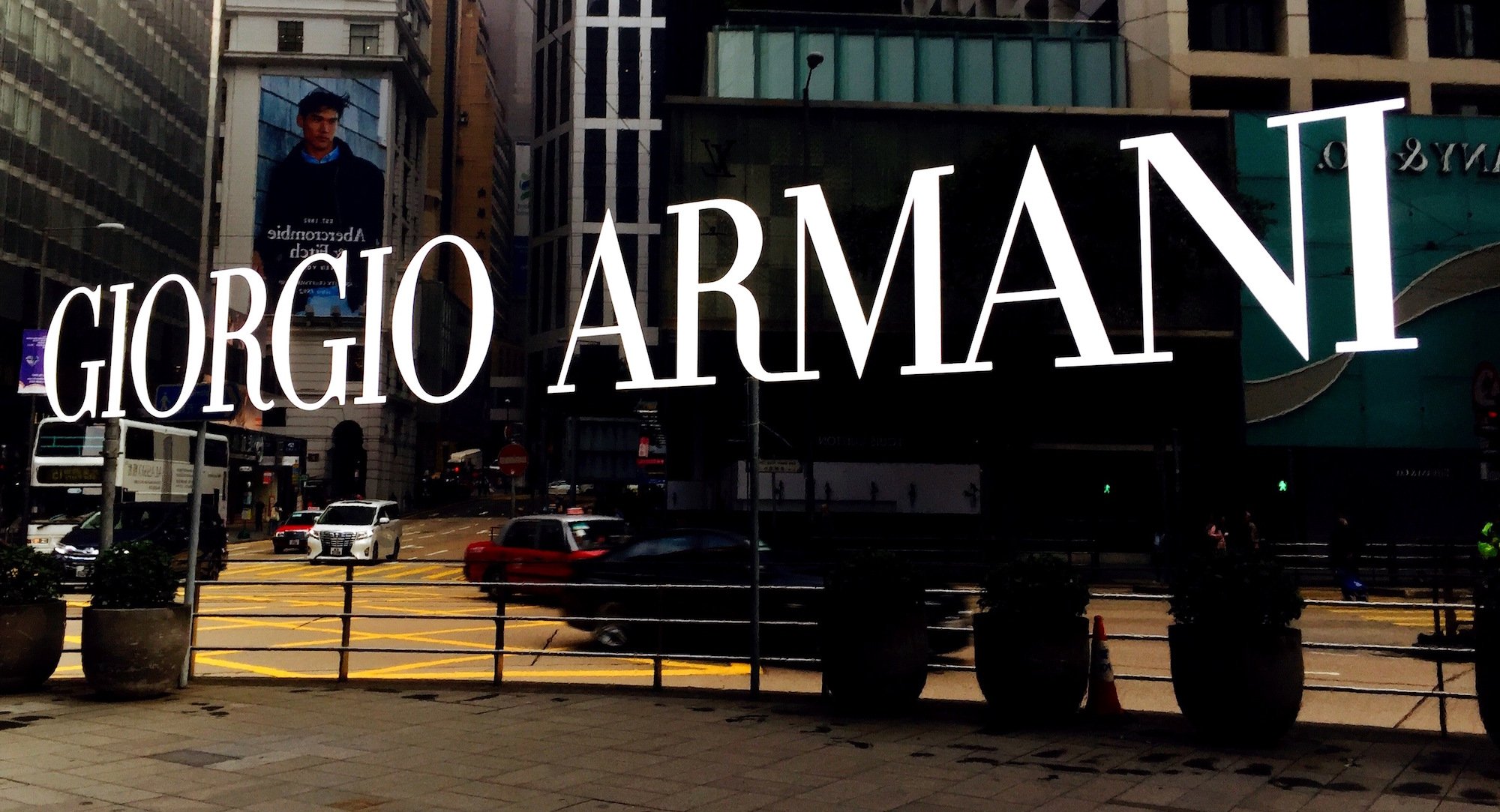
Giorgio Armani spent 50 years refusing to sell. He turned away suitors, stayed off the stock market, avoided debt and remained sole shareholder, chief executive and creative director of the company he founded in Milan in 1975. When he died on 4 September 2025, aged 91, his will instructed his heirs to do what he never would: bring an outside shareholder into the company, beginning with a 15% stake, and later sell a larger holding or list the business.
That instruction defines the central tension of the Giorgio Armani brand. Its strength was built on one man’s taste, discipline and control. Its future depends on whether that strength can be carried by an institution: a foundation, a board, a management team and a new generation of designers. Few luxury houses have faced the founder question in such a pure form, and few founders have answered it with such a detailed plan.
The business he left is one of the best-known names in fashion. The Armani Group reported net revenues of USD 2.6 billion for 2025 (year ended December 2025). Including sales made by its licensees, Armani-branded turnover was about USD 4.7 billion. The name covers haute couture and jeans, fragrances and eyewear, furniture, restaurants and hotels.
This article examines how the brand was built, how it is structured, how its ownership and governance were designed for the years after the founder, and which challenges lie ahead.
The Giorgio Armani brand has earned a much hallowed space in the fashion industry through its superior design, relevant themes and trends. It maintains the aura of a real luxury brand. Giorgio Armani has become one of the most respected and known brand names in the fashion and luxury brand industry, and it is one of the few global fashion houses of its size still in private hands.
Born in the northern Italian town of Piacenza in 1934, Armani later studied medicine at the University of Milan before leaving for military service. In 1957, Armani took a job as a window dresser at Milan department store La Rinascente, where he worked up to a buyer position, marking his first foray into fashion. In 1964, Armani started working as a designer for Hitman, the menswear line of Nino Cerruti. During the 1960s he met Sergio Galeotti, an architectural draftsman who encouraged him to work under his own name. In 1975, Giorgio Armani started the company with Galeotti.
The two partners founded Giorgio Armani S.p.A. in Milan in 1975, financed in part by the sale of their Volkswagen Beetle. Armani designed and Galeotti ran the business. The arrangement allowed the designer to concentrate on a single idea: taking the stiffness out of tailoring. He removed the padding and lining from the man’s jacket, worked in softer fabrics and a muted palette, and then applied the same thinking to suits for women. The unstructured jacket became the signature of the house and one of the most influential garments of the late twentieth century.
International recognition came quickly, and it came through cinema. In the 1980 film American Gigolo, the character played by Richard Gere chooses his clothes from a wardrobe of Armani, and the film introduced the look to a mainstream audience. In 1982 Armani appeared on the cover of Time magazine, the first fashion designer to do so since Christian Dior four decades earlier. Through the 1980s the Armani suit became the uniform of a generation of executives, and of the women moving into senior roles alongside them.
The suit for women mattered as much as the suit for men. As women moved into management in large numbers during the 1980s, the Armani jacket offered a way to dress for authority without imitating the tailoring of men. Museum curators have since compared his influence on how people dress to that of Coco Chanel.
Galeotti died in 1985, aged 40. Many in the industry doubted that a designer could also run the company. Offers to take a stake in the business followed, and he later recalled his answer: he could do it alone. Armani took on both roles and held them for the next four decades. He extended the brand step by step: Emporio Armani for a younger customer in 1981, a beauty licence with L’Oréal and an eyewear partnership with Luxottica in 1988, A|X Armani Exchange in 1991, the Armani Privé haute couture collection in 2005 and the first Armani hotel in 2010.
Being a designer himself, Armani made apparel with his sense of aesthetics, beauty and luxury, a sense that appealed to the elite of the society. The company remained privately held throughout his life, with the founder as sole shareholder. With many sub-brands designed under the parent umbrella brand of Giorgio Armani to cater to the specific needs of different market segments, it has become one of the strongest fashion and luxury brands in the world. The brand is built on 3 pillars: class, quality and exclusivity. Its product lines cover all corners of fashion, including apparel, swimwear, accessories, perfume, cosmetics, watches, eye wear, bags and shoes for men, women and kids.
Giorgio Armani expanded early in Asia Pacific, with its important growth markets for luxury brands. In China, Giorgio Armani was one of the forerunners among international fashion houses. It opened its first boutique in Beijing in 1998 and Giorgio Armani and Emporio Armani stores at Three on the Bund in Shanghai in 2004, and has been opening stores across China since then.
Throughout, Armani kept ownership to himself. He declined approaches from larger groups and from investors, funded growth from the company’s own cash and stayed free of debt. Asked in 2024 why he had never sold, he said he felt he still had much more to do on his own, and admitted to a touch of personal pride. In 2016 he created the Giorgio Armani Foundation and adopted new company bylaws designed to take effect on his death. He continued to oversee every collection into his nineties. In June 2025 illness kept him away from his own runway shows for the first time. He died in Milan on 4 September 2025, weeks before the celebrations planned for the company’s 50th anniversary. More than 15,000 people came to the company’s headquarters to pay their respects.
The group he left is organised around three fashion brands: Giorgio Armani, Emporio Armani and A|X Armani Exchange.
At the time of its 2025 results it operated 138 Giorgio Armani stores and 308 Emporio Armani stores worldwide. Europe is its largest region and accounted for about half of net revenues in 2024. Revenue fell by 5% in 2024 and by 2.8% in 2025 at constant exchange rates as demand for luxury goods weakened across the sector. The group nevertheless continued to invest in its flagship stores, brought its e-commerce operations in-house and ended 2025 with a substantial net cash position.
Unlike the usual practices of branding that are normally seen in the consumer goods industry, the branding philosophy in the fashion and luxury goods industry is quite unique and personality based. Most of the famous fashion houses like Christian Dior, Yves Saint-Laurent, Gucci, Versace and many others were built on the personality of the founders. As design is the most important ingredient of fashion and luxury apparel, the individual style of these designers becomes crucial to creating and sustaining the fashion brand strategy. It is these unique designs and patterns that reflect the personality of their creator that gives an identity to the brand and helps to differentiate it from the crowd.
The Giorgio Armani fashion house, like many other fashion houses, has been built primarily on the unique personality and identity of Giorgio Armani himself. The brand takes on the identity of the founder through the designs created.
Though this aspect of the fashion industry provides fashion houses with a strong sense of differentiation that can be conveyed in a tangible and visual form, it also poses a serious threat. When an entire brand and fashion house are built on the basis of the founders’ personality and identity, it becomes a major challenge to keep the brand going after the demise of the founder, something many of the fashion houses have realised in the recent past.
Four ideas run through the Armani brand philosophy. They explain its consistency over five decades, and they explain the nature of the challenge the company faces without its founder.
Understatement as luxury: Armani built his house on restraint. Soft construction, neutral colours and discreet branding set the main line apart from the more decorative fashion of the 1980s, and anticipated by decades what the industry later called quiet luxury. Armani himself kept his distance from the term. He saw his work as a constant process of simplification that adds meaning to a garment, and said in 2025 that quiet luxury tends towards the merely simple. He described the world he had created as one of natural sophistication in which nothing is overdone.
The bylaws he adopted in 2016 bind his successors to the same direction: a style that is essential, modern and free of ostentation, with attention to detail and to how the clothes wear.
Consistency over trend: Armani did not chase seasonal fashion. He refined the same vocabulary year after year and accepted the criticism that came with it, holding that style should prevail over trends. The result is a brand whose jackets from the 1980s are sought after by buyers who were not born when they were made. Consistency is also a commercial discipline. It gives customers a reason to return, supports the value of the product over time and reduces the brand’s dependence on any single season.
Control as method: Armani approved every collection, styled his own shows and applied the same eye to stores, furniture, hotels and advertising. “My greatest weakness is that I am in control of everything,” he told the Financial Times in an interview published in August 2025, days before his death. Control gave the brand a coherence across categories that few competitors could match. It also meant that the organisation had limited experience of taking decisions without him.
Rooted in Milan: Armani was inseparable from Milan and from Italian manufacturing. He lived and worked in the city and showed his ready-to-wear collections there, and the group runs its own manufacturing operations in Italy. In 2024 he said he hoped Italian fashion would remain a symbol of industriousness and craftsmanship as well as of image. The foundation he created is charged with maintaining employment as well as creating value. Country of origin is part of the equity of the brand, and the succession plan treats it as something to be protected.
For leaders, the implication is that a brand philosophy must be explicit enough to survive its author. Armani’s principles were lived daily by one person for 50 years. The work of the next decade is to translate them into codes, processes and judgement that others can apply.
Whenever a brand gains popularity and acceptance from its target customers in its core business, the next obvious step for the brand is to charter a new course by venturing into different product lines, different segments, and ever different markets. This phenomenon seems common across industry sectors.
Giorgio Armani with its iconic popularity amongst the elite of the society and the fashion literate segment of the market has followed similar steps by extending the brand. The Armani brand architecture encompasses one corporate brand and three core fashion brands, each catering to different sets of target customers and at different price levels.
The signature Giorgio Armani line: This is the main collection of very high quality classic apparel that consists of the signature Armani suits, Oscar gowns and so on, which are of the ultra-premium price points and essentially targeting consumers in the 35 to 50 year old age group. The signature brand also houses the Armani/Casa home collection and the Giorgio Armani Privé haute couture line.
Emporio Armani: Targeted especially at the young professional segment in the 25 to 35 year old age group, the Emporio Armani brand provides fashionable and contemporary designs that are relevant to the target customers. Launched in 1981, Emporio Armani absorbed the Armani Collezioni and Armani Jeans lines in the 2017 reorganisation. In September 2026, Dario Vitale, formerly of Miu Miu and Versace, was appointed creative director of Emporio Armani and of Giorgio Armani accessories, the first designer from outside the Armani family to hold a creative director role at the group.
EA7: EA7 was launched in 2004 as the sports line of Emporio Armani. It was created for everyone who loves exceptional style and wants to maximise their experience from sporting activity. This fashion label caters to a wide range of sport including running, fitness, golf and winter sports. EA7 has dressed the Italian Olympic and Paralympic teams since the London 2012 Games.
A|X Armani Exchange: Launched in New York in 1991, this is the most accessible brand of the Armani fashion house. It was run for many years through a licence and a joint venture, and the group took full ownership in 2014. This serves as the ultimate testimony to the power of the brand. By providing the entire range of its apparels and accessories, Armani Exchange provides customers with the complete feel of the luxurious fashion of Giorgio Armani. A|X Armani Exchange offers casual fashion of a good quality – which is exactly what the mass market of consumers desire.
Alongside these brands sits the haute couture line, which continued through the reorganisation of the portfolio:
Giorgio Armani Privé: This is Armani’s couture line developed in 2005 for the red carpet. It offers gala and award-show wear including gowns and suits that are ultra-luxurious, exemplifying the understated chic that epitomises the essence of the Giorgio Armani brand. This line is almost exclusively targeted at the rich and famous. It forms part of the Giorgio Armani brand.
In 2017, the Armani Group reorganised its portfolio around Giorgio Armani, Emporio Armani and A|X Armani Exchange to give each brand a clearer position. The following lines were absorbed and their names retired:
Armani Collezioni: This was Armani’s venture into a slightly lower priced market segment. It basically catered to the segment of people who aspire to wear high quality Armani apparel but cannot afford the ultimate signature line, or to those who crave to add extra products to their existing portfolios. The Armani Collezioni brand, with a price point of almost 20% lower than the main line, provided an excellent line of affordable fashion. The line was merged into Emporio Armani.
Armani Jeans: This was the lowest range of Armani apparel. This Armani brand was to the value segment what the signature line is to the premium segment. Catering necessarily to the young adults in the 18 to 30 year old age group, the Armani Jeans collection provided a trendy yet fashionable and luxurious line of apparel. It was divided between Emporio Armani and A|X Armani Exchange.
Armani Junior: This kids fashion brand was designed specifically for infants and children. The brand is best known for its sophisticated simplicity, sleek tailoring and classic colours. Taking inspiration from the adult line, sumptuous materials and attention to detail are combined to create a collection which is synonymous with quality.
The logic of this architecture is that of a pyramid. Haute couture and the Giorgio Armani line sit at the top and create the aura of the brand. Emporio Armani carries that aura to a wider and younger customer. A|X Armani Exchange and the licensed categories of beauty and eyewear provide volume at accessible prices. Each level borrows prestige from the one above and returns scale and visibility.
The model works only as long as the top of the pyramid stays strong. If the signature line loses authority, every level below it loses its reason to exist. This is why the 2017 decision to reduce the number of brands mattered. Fewer names made the hierarchy easier for customers to read and easier for the company to manage. The top of the pyramid held in 2025: Giorgio Armani Privé and the Giorgio Armani boutiques grew at double-digit rates while group revenue declined.
The same thinking has guided distribution. The group has shifted towards its own stores, which account for about half of revenue, and has become more selective in wholesale, a channel in which a brand has less control over presentation and price. In 2025 direct retail sales rose by 2% at constant exchange rates, while sales through indirect channels fell by 7%, mainly on lower wholesale orders.
The corporate brand and sub-brands help Giorgio Armani to operate in many segments of the fashion apparel market. But this is not all. Not only does Armani straddle many segments of the same product category, but also many different product categories.
Leveraging its strong brand equity in the fashion apparel market, Giorgio Armani has ventured into other related categories like eye wear, watches and cosmetics. These are made available in each of the above-mentioned brand categories to ensure that it is available to the different segments of the market. It is usually argued that eye wear, perfumes, watches and cosmetics are strongly related to fashion and luxury and thus it is natural for fashion houses to extend their brands into these categories. Giorgio Armani is a very strong example for this argument. By leveraging its expert knowledge of the fashion and luxury industry, Armani has been able to come up with winning concepts in the other product lines of cosmetics, watches, jewellery, eye wear, underwear and loungewear.
Two of these categories are run through long-term licences that are central to the group’s economics and, since 2025, to the question of its ownership. L’Oréal has held the licence for Armani fragrances, make-up and skincare since 1988, and in 2018 the agreement was extended to 2050. EssilorLuxottica produces and distributes Armani eyewear under a partnership that dates back to 1988 and was renewed in 2022 for 15 years, to the end of 2037. Sales made by licensees are not included in the group’s net revenues, which is why Armani-branded turnover is almost twice the reported figure.
Licensing has allowed Armani to reach a far wider public through a bottle of Acqua di Giò or a pair of sunglasses, without investing in the manufacturing and distribution those categories require. It also creates dependence on partners. This helps to explain why Armani named both licensees in his will as preferred future shareholders.
But Armani has not stopped at fashion as a product category. Armani has extended the brand into multiple other categories, such as:
Armani/Casa (home collection): This brand shows how Giorgio Armani presents his ideal for living, his dream of the perfect environment: an intimate and comfortable space in which to relax, unwind and entertain. It offers up-market furniture, home accessories, textiles and decorative objects, as well as interior design services for a variety of spaces including yachts, planes and villas. Its interior design studio also works on branded residential projects, among them Armani Residences Diriyah in Saudi Arabia.
Armani Beauty (fragrances and cosmetics): This beauty line reflects the signature Armani sophistication in its makeup, skincare and fragrances. It is developed and distributed by L’Oréal under a licence that runs to 2050, and includes fragrances such as Acqua di Giò. Armani Beauty also includes the haute couture fragrance line Armani Privé, which focuses on showcasing the natural beauty of a single precious ingredient. One of the precious ingredients used in its fragrances is the Damask Rose, which requires precise extraction methods.
Armani-branded Dolci (confectionery): This is Armani’s confectionery line focused on the concept of sophistication in gifting. It offers pralines, chocolates, jams, honey, tea, bakery products and more with its signature ‘A’ logo. The range of products is exclusive and distinguishes itself not just by its high quality but also the rich and sophisticated image of its refined packaging.
Armani-branded Fiori (flowers): Armani/Fiori was created in 2000 and brings the refined taste and sophistication of the Armani style to the world of flowers and floral décor. The boutiques offer arrangements and decorative elements with clean lines in sophisticated colours. It also offers complete and personalised services and events – clients are attended to and carefully guided through the selection of their ideal floral arrangements or décor.
Armani Ristorante and Caffes (restaurants and cafes): This was a bold move by Armani to enter the food business, but it has been proven a success thus far. The first Armani restaurant opened in Paris in 1998, and the group counts more than 20 restaurants and cafés on four continents, in cities including Milan, Tokyo, Munich and Dubai. Its restaurants are located in prime cities, are impeccably designed and offer only the best cuisine that allows diners to dine in style, reflecting the brand philosophy. In August 2025, Armani also agreed to acquire La Capannina di Franceschi, the historic venue in Forte dei Marmi where he had met Galeotti in the 1960s.
Armani Hotels (hotels): Armani expanded into the hospitality industry through a partnership with Dubai-based property group Emaar to develop a chain of Armani branded hotels and resorts. It unveiled its Armani Residences, a luxury collection of 144 private residence homes in the Burj Khalifa in Dubai, the tallest building in the world, in 2007 and its Armani Hotel Dubai in the same building in 2010. In 2011, it launched Armani Hotel Milano in the Manzoni 31 building, right at the heart of the prestigious Quadrilatero della Moda. In January 2026, the group formed a 20-year joint venture with Symphony Global, the private investment company of Emaar founder Mohamed Alabbar, with worldwide exclusivity to develop future Armani Hotels & Resorts. The partners plan a lifestyle-oriented hotel concept alongside the existing luxury format. Aman has travelled the same road from the opposite direction, extending a hospitality brand into residences, ready-to-wear, skincare and furniture.
Armani Clubs (premier nightclubs): Armani has also opened premier nightclubs in Milan and Dubai, distinguished by their discreet character, impeccable design and refined elegance.
Armani/Silos (museum): To add to this wide portfolio of brands, Armani opened Armani/Silos in April 2015 in Milan to mark 40 years of his career. The museum is designed with the Armani design philosophy and creative dynamism in mind by preserving the building’s unusual beehive form and incorporating geometric and uniform elements. The museum showcases the designer’s 40-year career, including 400 outfits and 200 accessories from Armani’s ready-to-wear collection from 1980 to the present.
All of these other product lines embody, in all its facets, Giorgio Armani’s personal aesthetic philosophy, which is based on the signature qualities of elegance, sophistication and comfort.
As is the trend in the fashion industry to operate in the entire spectrum from apparel, jewellery, cosmetics, watches, perfumes and luxury hotels, Armani has been able to leverage its brand equity to be present in most of these lucrative sectors. Giorgio Armani is truly a success story of classic brand management – appealing to people through its entire brand experience and philosophy, rather than only through its products.
Behind the architecture lies a strategy that Armani applied with unusual consistency. It can be summarised in five principles.
The implication for brand owners is that coherence compounds. Each of these principles is simple. Holding all five for 50 years is what made Armani so difficult to copy.
Armani understood earlier than most designers that a fashion brand is built as much by who wears it as by what it sells. He did not rely on advertising alone. He placed the brand in settings that gave it meaning, and four of them stand out.
Cinema: American Gigolo was the start of a long relationship with film. Armani clothes have appeared in more than 200 films, among them The Untouchables, Goodfellas and The Wolf of Wall Street, and Martin Scorsese directed a short documentary about the designer, Made in Milan, in 1990. Film gave the brand something advertising could not buy: characters whose authority and ease audiences wanted for themselves.
The red carpet: In 1988 Armani opened an office in Los Angeles dedicated to dressing actors, about a decade before other fashion houses recognised the value of celebrity dressing. Jodie Foster, Michelle Pfeiffer, Julia Roberts, Cate Blanchett and George Clooney became associated with the brand over the following decades. The approach turned award ceremonies into a recurring global stage for the brand and made Armani the reference for evening wear. It has since become standard practice across the luxury industry.
Sport: Sport gave the brand reach beyond the luxury customer. Armani bought the Olimpia Milano basketball club in 2008, and EA7 has been the official outfitter of the Italian Olympic and Paralympic teams from London 2012 to the Milano Cortina 2026 Winter Games. The association links the brand to performance, to national pride and to a younger audience.
Places: Armani also communicated through buildings. The Armani/Manzoni 31 complex in Milan brings together stores, a restaurant, a club and the Armani hotel under one roof. Armani/Silos presents the archive to the public, and the decision to build the headquarters in a former industrial district of the city helped to regenerate the neighbourhood.
Museums have treated his work as part of design history, beginning with a retrospective at the Guggenheim Museum in New York in 2000. For the company’s 50th anniversary, an exhibition of his work opened at the Pinacoteca di Brera in Milan in September 2025, the first the museum has dedicated to fashion. Each of these places lets the customer experience the Armani aesthetic as a complete environment.
The task for the new leadership is to keep these platforms current for customers who discover brands on a screen long before they enter a store. The principle remains sound: the brand is strongest when it is seen in a context that carries meaning of its own.
Sustainability is a value that resonates strongly with Armani. With its clean lines and understated elegance, Armani’s designs have always been built with enduring substance to last through fashion trends, as opposed to be thrown away after one season. Armani stated that it was his wish for the fashion industry to slow down collections and produce less but of better quality.
The Armani Group’s commitment to sustainability is expressed across 5 areas:
Customers: To ensure the best customer experience, Armani Group guarantees product safety and authenticity through its QR code project, allowing customers to access the Group’s product authentication process.
Supply Chain: Besides including sustainability criteria in its supplier selection process, the Armani Group works to reduce environmentally-unfriendly chemicals through centralised management of chemical tests and restricting these substances from its supply chain.
The supply chain has also brought scrutiny. In April 2024, a Milan court placed the group’s manufacturing unit, G.A. Operations, under judicial administration over the supervision of subcontractors working for its suppliers. The court lifted the measure early, in February 2025, recognising the results the company had achieved in its control systems. In August 2025, Italy’s competition authority fined the group about USD 4 million, finding that its statements on ethics and social responsibility were not consistent with conditions found at some subcontractors. The Armani Group rejected the finding and has appealed to a regional administrative court. Other luxury houses producing in Italy have faced similar proceedings. For a brand that manufactures through a long chain of suppliers, control of that chain has become part of brand management.
Environment: The Armani Group has signed the Fashion Pact, a series of pledges aiming to make the industry greener by eliminating greenhouse gas emissions, restoring biodiversity and protecting species, and protecting oceans. Its targets for reducing greenhouse gas emissions by 2030 have been approved by the Science Based Targets initiative, and its collections have been fur-free since 2016. It also chooses raw materials and packaging materials with the lowest environmental impact and opts for recyclable materials where possible.
Human resources: Armani respects diversity, protects equal opportunities, respects its employees’ work-life balance, and encourages employee growth through the Armani Development Programme, its corporate training plan.
Community: Through its investments and efforts in providing clean water access and promoting culture, Armani gives back to the community in which it operates. For example, it has partnered L’Oréal in the Acqua for Life project, which provides clean water access and education in communities on several continents.
During the coronavirus pandemic, Armani also converted its factories in Italy into production centres to make single-use medical protective overalls for healthcare workers amid supply shortages. Additionally, it donated USD 2.2 million to Italian hospitals to help combat the virus.
Giorgio Armani had no children, yet his company was in every practical sense a family business. His sister, two nieces and a nephew sat on its board, three of them worked in the group, and his closest collaborator, Pantaleo (Leo) Dell’Orco, was regarded as part of the family. In the founder’s final years, Silvana Armani and Dell’Orco headed womenswear and menswear design, Roberta Armani led entertainment and VIP relations, and Andrea Camerana was responsible for sustainability.
The question every founder-led enterprise must answer was therefore posed in an unusually sharp form: how to pass on a business whose value rested on one person to heirs who had spent their careers working beside him. Armani prepared his answer over almost a decade. It deserves close study by any owner family.
A plan prepared in advance: In 2016 Armani established the Giorgio Armani Foundation and called an extraordinary shareholders’ meeting to adopt bylaws that would come into force on his death. The documents, which became public in 2023, divide the share capital into classes with different voting rights, give the board a central role, call for a cautious approach to acquisitions and provide for half of net profits to be distributed to shareholders. The foundation’s task is to hold its shares for the long term, with the aims of creating value, maintaining employment and upholding the values of the company. The model has a precedent in Swiss watchmaking: Rolex has been owned by a foundation since the death of its founder, Hans Wilsdorf, in 1960.
What the will provides: The will, published in September 2025, sets out the structure in detail. The foundation holds 10% of the capital and 30% of the voting rights. Dell’Orco holds 40% of the votes. Armani’s niece Silvana Armani and his nephew Andrea Camerana hold 15% each. His sister Rosanna Armani and his niece Roberta Armani hold shares without voting rights. Together, the foundation and Dell’Orco control the company. The foundation also has the right to the stakes of the other shareholders on their death. The will then instructs the heirs to open the capital in stages:
A new shareholder could therefore own close to 70% of the capital within five years, while the foundation would still hold a veto over the decisions that matter most. Armani opened the door to a change of ownership and, in the same document, limited what any new owner can do. The instructions also carry legal force. Under Italian law the provisions of a will bind the heirs and can be challenged in court if they are not carried out.
Why these three partners: The preferred investors were chosen with care. L’Oréal has been the beauty licensee since 1988 and is bound to the brand until 2050. EssilorLuxottica has made Armani eyewear under a partnership first agreed with Luxottica founder Leonardo Del Vecchio in 1988, and Armani was himself a shareholder in the eyewear group, with a stake of about 2% that he left to his heirs and senior managers. LVMH is the largest luxury group in the world and has experience as a minority investor in Italian family companies. The relationship had a history of its own. Armani said in 2024 that Bernard Arnault, chairman and chief executive of LVMH, had been the first to propose a joint venture to him. Each would bring something different: the protection of a profitable licence in two cases, and scale and expertise in luxury retail in the third. Analysts are divided on which would be the best fit, and the will leaves that judgement to the foundation and the heirs.
Governance after the founder: Implementation has followed the plan. In October 2025 Giuseppe Marsocci, who had spent 23 years with the group, was appointed chief executive on the proposal of the foundation. Dell’Orco became chairman and Silvana Armani vice-chair; the two also lead menswear and womenswear design. In November 2025 a new eight-member board was named, combining family members with outside directors such as former Gucci chief executive Marco Bizzarri and Yoox founder Federico Marchetti. In September 2026 the first creative director from outside the family took charge of Emporio Armani. The will also left shares in EssilorLuxottica to a small group of senior managers, among them Marsocci, a sign of the weight the founder gave to executives from outside the family.
Owner, steward and operator: Family members can hold three roles in an enterprise: owner, steward on the board and operator in management. Giorgio Armani held all three for 50 years, and his plan divides them. The heirs and the foundation are the owners. The foundation, with its permanent stake and its veto, and the board are the stewards. The operators are a chief executive from outside the family and the heads of design. Dell’Orco and Silvana Armani hold all three roles at once, as shareholders, as chairman and vice-chair, and as heads of menswear and womenswear design. That gives continuity in the first years. It also asks two people to keep apart roles that the founder never had to distinguish. Inditex, the owner of Zara, has divided the same roles in a different way: the next generation holds the chair as steward, and a professional chief executive is the operator.
The sale process: The first deadline falls in March 2027. LVMH, L’Oréal and EssilorLuxottica have each indicated publicly that they are open to the possibility. Bernard Arnault, chairman of LVMH, said the designer had honoured the group by naming it as a potential partner. In September 2026 Marsocci said the stake could go to more than one investor: “It is not written in stone that it has to be one investor.” He added that no decision had been taken and that the company intends to respect the founder’s timetable, subject to agreement on price and terms. Analysts at Berenberg estimated the value of the company at between USD 5.9 billion and USD 8.2 billion in September 2025. No valuation has been confirmed by the company or by any prospective investor.
What owner families can learn: The Armani plan is not a template. It reflects one founder, one company and Italian law. It does illustrate five principles that apply to family enterprises well beyond fashion.
The plan also carries risks that owner families should weigh. A will cannot foresee market conditions, and a fixed timetable may require a sale at a moment that favours the buyer. Detailed instructions reduce the room for disagreement among heirs, but they also limit the freedom of the next generation to adapt. Every family must find its own balance between the wishes of the founder and the judgement of those who follow, and that balance rests on family unity, harmony and cohesion.
For the heirs, the transition is also one from operating owners to holders of significant financial wealth. That shift calls for its own governance, which is why many business families establish a family office alongside the operating company.
The founders’ dilemma: This phenomenon is classic and occurs for any company that is built on the basis of a strong and charismatic founder and leader. As the main competitive advantage for the company is the founder/leader himself, neither the founder nor the company would think of life after the founder. Moreover, whenever the companies’ success and survival depends very heavily on the existence of a single person, such companies and its leaders should take proper action from an early stage so that proper leaders can be nurtured within the organisation.
Giorgio Armani led the company as chief executive and creative director for 50 years, from the inception of the family business until his death in September 2025. Unlike many founders, he prepared for that moment. The foundation created in 2016, the bylaws and the will together form one of the most detailed succession plans seen in the luxury industry, and he said shortly before his death that he wanted a gradual transition and no rupture. The dilemma has not disappeared. It has changed form. The question of who owns and leads Armani has been answered for the time being.
The open question is whether a structure of several people can exercise the judgement that one person exercised for five decades.
The key to success will be for the Group to maintain a transparent process where family talent is compared with external talent in order to select the best leaders to take the brand to new heights. The appointments of a long-serving executive as chief executive and of an external designer at Emporio Armani are early signs of this approach. Leadership needs to keep in place a solid succession plan for every key role to ensure business continuity of the brand and company.
Creative renewal after the founder: For 50 years the creative direction of every Armani line came from one person. The collections shown since his death were designed by Dell’Orco and Silvana Armani, who worked beside him for decades, and continuity has been the priority. The appointment of Vitale at Emporio Armani is the first step towards new creative voices. The challenge is one of calibration. With too little change, the brand risks speaking only to the customers it already has. With too much, it loses the consistency that defines it.
Chanel and Dior both found renewed strength under designers who reinterpreted the codes of the house long after the founder had gone. The lesson is that the codes must be clear enough to be handed on. Accessories, which carry some of the highest margins in luxury, remain a small part of the Armani business, and Marsocci has described them as a growth opportunity.
A changing luxury customer: The transition coincides with a difficult market. Demand for luxury goods has weakened for more than two years, most of all among aspirational customers, who buy occasionally and are sensitive to price. Presenting the 2025 results, Marsocci spoke of a possible structural change in the way customers approach luxury and fashion. Armani is exposed at both ends of its range. The couture and signature lines compete with the most exclusive houses, while Emporio Armani and A|X Armani Exchange serve the customers who have cut back the most. The response so far has been restraint on prices, investment in directly operated stores and a focus on full-price sales. The harder task is to give a younger generation of customers a reason to choose Armani.
Brand dilution due to over-stretch: Strong brands, as are well known, provide companies with a very powerful tool to enter newer markets with limited investments by leveraging their strong brand equity. It gives companies numerous revenue streams. Given this simple but strong fact, it is not a surprise that most of the strong brands in the world have leveraged their brand equity and extended their brands into newer product categories, newer markets and even newer market segments.
The examples that immediately come to mind are those of Calvin Klein and Pierre Cardin. One of the many reasons that these brands diluted their brand equity was because they used their brand names on a very wide range of products. One of the main factors that make fashion houses and their products premium are their exclusivity. By franchising their brand names to literally everything, these brands lost a significant portion of their strong brand equity. Armani will need to consider this strategically especially if it is planning to expand into other businesses. All categories should ultimately encapsulate the spirit of the Armani brand and serve to strengthen it.
The planned expansion of Armani hotels and the wide price range of the group, from haute couture to A|X Armani Exchange, make this discipline more important under shared ownership, when pressure for growth is likely to increase.
Managing brand architecture: Given Armani’s portfolio of brands within the fashion segment, as in many of the other markets that it operates in, effectively managing this portfolio of brands will prove to be the biggest challenge in the future. As the brand moves into different territories, interacts with different sets of customers, and represents different personalities, it becomes quite a task for maintaining consistency across all of its marketing communications and other activities. The reduction to three brands in 2017 addressed part of the problem. The position of each brand relative to the others, and to price, remains work in progress, and the company has confirmed that it is preparing a new business plan.
Maintaining financial independence: Armani is a rarity from a financial perspective as well. Giorgio Armani was effectively the only shareholder of the company until his death in 2025. The company has also avoided debt and holds net cash. Having this financial independence has helped Armani immensely as the company tests newer territories. With no pressures from shareholders and without having to bother about meeting quarterly targets, Armani has been able to operate quite successfully.
But to continue as a one-man company in the future could be quite difficult. With consolidation happening in many industries, it might just be a matter of time that it catches up with the fashion industry as well. When this happens, it could pose a big challenge to the working style of Armani and its continued success.
That moment has arrived, and by the founder’s own design. Consolidation has caught up with fashion. LVMH, Kering and Richemont accounted for 31% of global sales of personal luxury goods in 2023, up from 19% in 2014, according to Boston Consulting Group. In 2024 Armani told Bloomberg that independence could remain a driving value for the group, and added: “I don’t feel I can rule anything out.” Later that year he said that requests from outside to take a stake had become more insistent, and that for the moment he saw no opening. His will went further.
Other houses have taken different routes. Hermès pooled family shares in a holding company to protect its independence, while several Italian brands joined larger groups such as LVMH and Kering. Prada, another Italian family business, acquired Versace in 2025. Armani chose a middle path: a strategic partner, or a listing, with a foundation as permanent guardian.
The challenge for the heirs and the board is to secure a partner that brings capital and capability without diluting what made the brand valuable. The timing adds difficulty. The stake sale falls during a prolonged slowdown in luxury demand, and the group’s revenue has declined for two consecutive years. The foundation’s permanent stake and veto are designed to protect the brand through such a period. Whether they prove sufficient will depend on the quality of the relationship between the foundation, the family and the new shareholders.
Sustaining consistent brand personality: One of the main aspects of a fashion brand is its personality and its identity in the marketplace. Building and sustaining a personality that is relevant and one that resonates with the customer base is one of the most difficult aspects of building a strong brand. Armani, with its presence in diverse markets, a very wide brand portfolio, and interacting with diverse set of customers, faces this huge challenge of building a relevant and resonant personality.
Giorgio Armani built one of the most recognisable brands in the world on a consistent idea of style and on complete control of its execution. For 50 years the two were inseparable. The strength of the brand and the presence of the founder were the same thing.
His final decision was to separate them. The foundation, the staged opening of the capital and the division of roles are an attempt to turn a personal enterprise into an institution while keeping its character intact. It is among the most carefully designed successions the luxury industry has seen, and it will be tested in public over the next five years.
The verdict at this stage is cautiously positive. The brand has recognition far beyond its size, long-standing licensing partners, a strong balance sheet and a governance structure that gives it stability and time. What no structure can provide is creative energy and commercial momentum. Those must come from the people in charge.
Three tests will show whether the design works. The first is the choice of partner for the initial stake and the terms on which that partner enters. The second is creative renewal, at Emporio Armani in the first instance and in time at the signature line. The third is whether the governance holds when the interests of the foundation, the family and a new shareholder diverge, as they will at some point. A structure proves its worth in disagreement.
For leaders of founder-led and family-owned companies, the implication is clear. A brand built on a person can outlive that person only if the founder prepares the organisation to decide without him or her. Armani did so late in life, in detail and on his own terms.
The task for his successors is to honour the design without being confined by it.
Follow Martin Roll on LinkedIn >>
About the author: Martin Roll – Global Family Business & Family Office Expert
Read about luxury branding: Five Steps to Build a Strong Luxury Brand
Read about Hermès: Hermès – The Strategy Insights Behind The Iconic Luxury Brand
Read about Kering: Kering – Evolution of a Global Luxury Brand Company
Read about Prada: Prada – How An Italian Family Business Built An Iconic Luxury Brand
Read about Aman: Aman – The Strategy Behind The Iconic Asian Luxury Hospitality Brand
Read about Uniqlo: Uniqlo – The Strategy Behind The Global Japanese Fast Fashion Retail Brand
Read about Zara: The Secret of Zara’s Success: A Culture of Customer Co-creation
Read about retail branding: Retail Branding In The New Digital Age
Read about family business: The 3 Pillars of Success in Family Business: Family Unity, Harmony, and Cohesion
Read about stewardship: The Stewardship Imperative: How to Build Multi-Generational Success in Family Business
Read about family offices: What is The Purpose And Value of a Family Office? A Global Overview
Read more: Insights & Articles
Asian Brand Strategy provides key insights and knowledge about the rising Asian brands incl. model frameworks, brand cases and checklists on Asian branding. Download sample chapter.


